
Political Wire is now more than a quarter-century old, a long time for any publication and almost an eternity for one born on the early Internet.
When I started it, Google was barely two years old. There was no Facebook, Twitter or YouTube. Broadband was uncommon, newspapers were still figuring out the web, and the word “blog” had only recently entered the vocabulary.
Political Wire has survived enormous changes in technology, journalism, politics and the economics of publishing. Yet the basic idea has changed remarkably little: Find the most interesting political news, figure out what matters, give readers enough context to understand it and don’t waste their time.
The story actually begins a few years before Political Wire existed.
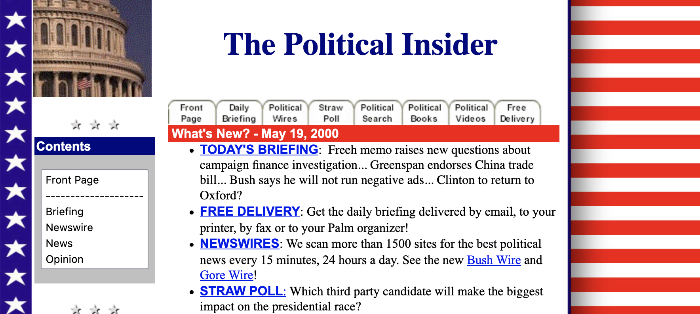
Political Insider
In 1997, Chris Riback and I had just finished You Won — Now What?, our book about the transition from campaigning to governing. The Internet was still in its infancy as a publishing medium, but we were intrigued enough by its possibilities to start a political news service called Political Insider.
Producing it required a routine that seems almost unimaginable today. I programmed my laptop to connect to the Internet over a dial-up modem at 4 a.m. ET and download political news stories before I left for work. I read them offline during my commuter train ride into New York City, where I was chief operating officer of an asset management firm.
During the ride, I sorted through the news and assembled a daily political briefing. Once I reached my office, I merged in contributions from Chris and published it, usually by 8 a.m. ET.
Political Insider also had an unusual business model for the early Internet. Rather than depend entirely on readers coming to our website, we syndicated the briefing to emerging sites including Dick Morris’s Vote.com, PoliticalWag.com, eVote.com and iVillage.
It was my first real lesson in something that would fascinate me for the next three decades: The Internet wasn’t simply creating new ways to publish information. It was creating entirely new ways to distribute it and build businesses around it.
Political Insider worked well as a morning briefing, but it had an obvious limitation.
Once we published the day’s edition, politics continued to happen.
And there was another name I had always preferred.
Political Wire
When Chris and I started Political Insider, I had actually wanted to call it Political Wire. Unfortunately, the domain politicalwire.com wasn’t available.
At the end of 1999, I finally had the opportunity to acquire the domain. By then, Chris no longer had enough time to continue working on Political Insider, so I decided to create something new.
Political Wire launched in early 2000, just as the presidential campaign was getting underway.
The name change mattered because I wanted readers to understand this wasn’t simply Political Insider with a different masthead. The new site would operate differently.
The crucial technological development was my discovery of Greymatter, one of the earliest pieces of blogging software. Its innovation seems trivial now: It allowed a publisher to post something through a browser and have it automatically appear at the top of the page in reverse chronological order.
At a time when websites were largely static pages that had to be manually updated, that was transformative. There was suddenly no reason to wait until the next morning to publish a political story.
Political Insider had been a daily briefing.
Political Wire became a continuously updated political news stream.
That remains the fundamental structure of the site today.

A Living ‘Washington Wire’
Although the technology behind Political Wire was new, the editorial inspiration was much older.
For years, I had been an avid reader of Washington Wire, the short political column that appeared every Friday on the front page of the Wall Street Journal. It was filled with political news, intelligence and observations, and I looked forward to it every week.
Political Wire was consciously conceived as a digital version without the limitations of a weekly newspaper column. I wanted a “living Washington Wire,” continually updated as the political world changed throughout the day.
That also distinguished Political Wire from much of the political blogosphere emerging at the time. Many of the best-known political blogs were built around argument, ideology or personality. Political Wire was primarily built around editorial judgment: finding the reporting and information that mattered, adding context when useful and presenting it efficiently.
The point was never to give readers everything.
It was to save them from having to read everything.
As the amount of political information online exploded, that filtering became more valuable. A reader should be able to visit Political Wire, quickly understand what was happening and move on with the rest of the day.
Then come back a few hours later to see what had changed.
In many ways, Political Wire has always been built around that return visit.
An Early Bet on RSS
The continuously updated format made Political Wire particularly well suited to another emerging technology: RSS.
On August 6, 2001, I announced Political Wire’s RSS 0.91 feed on an Internet syndication mailing list, describing the site as covering the latest political news and being updated frequently throughout the day.
RSS quickly became important in two ways. It gave readers a new way to follow Political Wire, but it also gave me a much more efficient way to monitor other publications. I became an aggressive user of feeds and sometimes created my own when an important news source didn’t offer one.
I was also interested in whether RSS could become a viable commercial publishing format. Political Wire is credited with being one of the first publishers to put advertising directly into an RSS feed.
That experiment brought me into conflict with Dave Winer, one of the principal creators of RSS. Winer had praised my use of the technology but took great offense when I started putting advertising into feeds.
In retrospect, the dispute seems almost quaint. Advertising and sponsorship eventually became commonplace in feeds, newsletters, podcasts and nearly every other digital format.
But the episode reflected a question that has interested me throughout Political Wire’s history: How could independent publishing on the Internet actually support itself?
The Moment Political Wire Broke Through
Political Wire grew steadily through the first half of the 2000s, but one moment in 2006 stands out as when I realized the site had become an important part of the political media ecosystem.
In the weeks before the midterm elections, Charlie Cook, Stuart Rothenberg and Chuck Todd all independently reached out to me. At the time, they were three of the country’s most closely watched election analysts, and each wanted me to feature his forecasts on Political Wire.
Until then, I had spent years searching for valuable political information and putting it in front of Political Wire readers.
Now the people producing some of Washington’s most valuable political information were coming to me because they wanted to reach that audience.
Political Wire had developed a particularly interesting readership. It wasn’t just people who enjoyed following politics. Reporters, campaign professionals, congressional staffers, lobbyists, public affairs executives and elected officials were reading it.
That audience also turned out to have considerable commercial value.
The ‘Meet the Press’ Model
In the early years, Political Wire’s advertising business looked very different from online advertising today.
Companies and advocacy organizations wanted to reach Washington decision-makers, and they were willing to advertise in publications that attracted them. I thought of this as the “Meet the Press model.”
A company advertising on a Sunday political program wasn’t necessarily trying to sell something to millions of viewers. It might simply want its message seen by the relatively small number of policymakers, journalists and opinion leaders who mattered to its business.
Political Wire offered a similar audience online.
This was before programmatic advertising came to dominate the Internet. Advertisers frequently bought space because they specifically wanted the readers of a particular publication, which meant publishers maintained direct relationships with advertisers.
By 2008, Political Wire had become a viable business earning good money.
That created an increasingly difficult choice because I was still working full time on Wall Street.
And 2008 was not exactly a quiet year in either of my jobs.
Two Jobs Collide
I was the chief operating officer of an asset management firm in New York City, a demanding job under normal circumstances. But in 2008, the financial markets were melting down just as the presidential race between Barack Obama and John McCain produced one of the most intense political news cycles I had ever covered.
I was essentially working all the time.
Political Wire had grown far beyond the side project it had once been, and I began seriously considering leaving Wall Street to run it full time. The site was already profitable, but walking away from an established career was still a major decision.
Then Congressional Quarterly approached me.
Breakfast in Denver
Congressional Quarterly initially wanted to buy Political Wire.
CQ needed more digital advertising inventory, and Political Wire had exactly the sort of Washington audience its advertisers wanted. Its executives asked to meet with me over breakfast during the 2008 Democratic National Convention in Denver.
I wasn’t interested in selling, so I suggested something else.
Instead of buying Political Wire, CQ could lease all of its advertising inventory for four years. I would receive guaranteed payments along with some of the upside if CQ sold more advertising, while retaining complete ownership and editorial control.
The structure worked well for both sides. CQ got the inventory it wanted, while I locked in predictable revenue at precisely the moment I was considering giving up my Wall Street salary. The agreement later survived The Economist Group’s acquisition of CQ and its combination with Roll Call.
In retrospect, that breakfast in Denver was one of the most important business moments in Political Wire’s history.
I had been offered the opportunity to sell the site and instead found a way to use the interest from a larger media company to make Political Wire more independent.
Thirteen Minutes
I finally left my Wall Street job in April 2009.
Political Wire was already a viable business, and the guaranteed revenue from the CQ agreement made the decision considerably easier. But that didn’t eliminate the psychological difficulty of walking away from a good job and an established career.
On my last day, it took me about 13 minutes to walk from my office to the train. For those 13 minutes, I nervously wondered what I had just done.
I had left a secure and successful career to become an entrepreneur running a political website, something that would have sounded fairly ridiculous not many years earlier.
Then I got on the train.
I never thought about it again.
Taking the Business Back
The advertising agreement with CQ lasted four years. When it expired in 2013, I decided not to continue it.
I missed having control over the business side of Political Wire.
One of the things I’ve always enjoyed about digital media is figuring out how to make a website economically viable. The Internet never stops changing, which means the business of publishing on it never stops changing either.
Leasing Political Wire’s advertising had given me predictability when I needed it. But I wanted control over monetization again.
That desire for control — editorially and commercially — would become increasingly important as the economics of digital publishing changed.
The Romney Transition Site
Political Wire has always primarily found and highlighted the best political reporting elsewhere, but occasionally a major story comes directly to me.
One of the biggest arrived immediately after the 2012 presidential election.
Mitt Romney had just lost to President Obama when I received an anonymous tip about a website his transition team had prepared in case he won. The site was publicly accessible.
It offered a fascinating glimpse of an alternate political reality in which Romney had become president-elect. There were pages for his transition, Cabinet and inauguration. Paul Ryan was identified as vice president-elect. Visitors could even apply for jobs in the incoming administration.
I captured screenshots and published them on Political Wire before the site disappeared.
The story took off almost immediately. Political Wire received more than a million readers in roughly 24 hours, an extraordinary amount of traffic for the site at the time. News organizations around the world published stories based on the screenshots.
For a publication whose normal role was directing readers toward interesting political reporting, it was an unusual reversal.
Suddenly much of the political press was directing readers toward Political Wire.
Scaling Political Wire
As Political Wire grew, I could have followed the path of many successful digital publications and built a traditional newsroom around it.
That never particularly interested me.
Putting my name on the site — Taegan Goddard’s Political Wire — made it an intensely personal endeavor. People have helped me in many ways over the years, but nothing gets published without my approval.
At the end of the day, my name is on the site.
That doesn’t mean Political Wire remained small. Quite the opposite. The audience grew dramatically, the business became much larger, the membership program expanded, new products were introduced, and Political Wire’s reach and influence became greater than ever.
What remained concentrated was the editorial decision-making.
That’s important because Political Wire’s fundamental product isn’t simply the amount of political information it publishes.
It’s the judgment behind what gets published.
Every day there are hundreds of stories, columns, polls, interviews, newsletters and social media posts that could conceivably appear on Political Wire. My job is to reduce that enormous stream to something useful.
Political Wire has grown by serving more readers, developing new products, improving its technology and building a larger business without abandoning the editorial discipline that made it useful in the first place.
The editorial decisions are still the product.
A Direct Relationship With Readers
The next major change to the business began during another trip.
Over Thanksgiving weekend in 2015, I was making a roughly four-hour drive to pick up my son from college. During the drive, I started thinking seriously about launching a Political Wire membership program.
By then, digital advertising had changed dramatically. The direct relationships publishers once had with advertisers were increasingly being replaced by programmatic networks targeting readers across thousands of websites.
That provided some context for the membership idea, but it wasn’t the main reason I wanted to do it.
I simply preferred a model that gave me a more direct relationship with Political Wire’s readers.
I stayed in a hotel that night and decided to pull the trigger.
When I woke up the next morning, several dozen readers had already become paying members.
That’s when I knew the idea was going to work.
Why Membership
I later wrote a series of essays explaining the philosophy behind the membership model. My argument was fundamentally about incentives.
Under the old advertising model, a publication that attracted a valuable audience could sell advertisers access to it. Everyone’s interests were reasonably well aligned. A better publication attracted better readers, which attracted better advertisers.
Programmatic advertising weakened those relationships. Advertisers increasingly bought particular kinds of people across enormous networks rather than buying a particular publication. Publishers, in turn, had incentives to collect more data, generate more pageviews and create more advertising inventory.
Membership offered a simpler relationship.
Publishers were directly accountable to their readers.
That appealed to me because Political Wire had spent years building an audience that came directly to the site, often several times a day. Membership allowed the business model to reflect the relationship that already existed editorially.
Readers weren’t merely an audience being assembled for someone else.
They could become the customers.
Building for the Second Visit
That direct relationship reinforced something I had gradually come to believe about web publishing.
Most websites are obsessed with the first visit. They worry about how someone arrives from Google, Facebook or somewhere else and then try to squeeze as much value as possible from that visit through more pageviews, advertisements, recommendations and attempts to keep the reader from leaving.
Political Wire has always been more interested in the second visit.
If someone spends only a few minutes on Political Wire but gets exactly what they need, that’s fine. If the experience is useful enough that they deliberately return later in the day, that’s much more valuable.
Over time, this made Political Wire something of an anti-website. Conventional publishing wisdom increasingly favored long articles designed for search engines, aggressive use of images, attention-grabbing headlines and layouts engineered to produce additional clicks.
Political Wire remained primarily a chronological stream of relatively short posts.
The site wasn’t trying to trap readers.
It was trying to become a habit.
Surviving the Platform Era
That distinction became particularly important as Google, Facebook and Twitter transformed digital media.
Many publishers built enormous audiences on platforms they didn’t control. For a while, the strategy produced extraordinary traffic, but it also made those publications vulnerable whenever an algorithm changed or a platform decided news was no longer strategically important.
Political Wire benefited from search and social media, of course, but neither became the foundation of the business.
Readers continued to come directly to PoliticalWire.com, bookmark the site, subscribe to RSS feeds and later receive email updates.
That direct audience remained the core audience.
In a 2024 interview, I estimated that Political Wire typically received roughly three to four million visits a month outside the peak election period, with traffic potentially rising toward eight to ten million as a presidential election approached.
But the more important characteristic has always been the audience’s loyalty.
Political Wire isn’t primarily built around attracting millions of strangers.
It’s built around serving people who keep coming back.
Trial Balloon and the Return of Chris Riback
One of the pleasures of Political Wire’s later years has been reconnecting professionally with Chris Riback.
Chris and I had written You Won — Now What? together and spent several years producing Political Insider. More than two decades later, we wanted to work together again, and Trial Balloon became the vehicle.
A podcast obviously bears little technical resemblance to the daily political briefing we assembled in the late 1990s, but there’s a continuity between them.
Both grew out of the same friendship and the same shared fascination with politics.
In that sense, Trial Balloon brought part of Political Wire’s history full circle.
Building Around Membership
The membership program also evolved considerably from the relatively simple idea I contemplated during that Thanksgiving drive.
An ad-free site and exclusive analysis were obvious starting points, but over time I became interested in creating more tools and services for people who follow politics closely.
That has included the constantly updated Trending News page, Trial Balloon, the Weekly News Quiz, the Political Calendar, private RSS feeds, On This Day in Political History, access to publications such as Inside Elections and Ballot Access News, better archives, saved articles and other features.
In 2026, Political Wire added another round of improvements, including Reader Wire, Dark Mode and further enhancements to the calendar and archives.
The specific features will keep changing because technology keeps changing.
But the objective is the same one that motivated Political Insider in 1997: Make it easier for people who care deeply about politics to keep up with it.
The Business of Political Wire
One thread runs through this entire history: I’ve always enjoyed the business side of digital publishing almost as much as the editorial side.
Political Insider experimented with syndication. Political Wire experimented with RSS and advertising inside RSS feeds. Direct advertising took advantage of a specialized audience companies and advocacy groups wanted to reach.
The CQ agreement traded some control over advertising for guaranteed revenue at exactly the moment that guarantee was most useful. When I no longer needed the arrangement, I took control back.
Membership created a direct financial relationship with readers.
None of these was conceived as the final business model because there probably is no final business model for digital publishing.
Technology changes. Reader habits change. Advertisers change. New opportunities appear.
Learning how to make an independent website viable has always been part of the fun.
What Hasn’t Changed
What strikes me most when I look back over Political Wire’s history is how much has changed around the site while the basic idea has remained intact.
The first Political Insider briefings were assembled using stories downloaded over a dial-up modem. Since then, broadband changed how people used the Internet. Google transformed discovery. Facebook and Twitter transformed distribution and political conversation. Smartphones changed when and where people consumed news. Podcasts created another publishing medium. Membership technology made substantial subscription businesses practical for independent publishers.
Now artificial intelligence is beginning another transformation whose consequences are still difficult to predict.
Through all of it, Political Wire has continued to do essentially the same thing.
I look at an enormous amount of political information every day and decide what Political Wire readers should know.
Three Histories in One
Seen from a distance, Political Wire’s story is really three histories unfolding at once.
It’s a history of political journalism, beginning when newspapers and television still dominated the political information system, moving through the rise of blogs and social media, and continuing into today’s extraordinarily fragmented media environment.
It’s also a history of the Internet, from dial-up modems and static HTML through blogging software, RSS, broadband, search engines, social networks, smartphones, podcasts, subscription platforms and artificial intelligence.
Finally, it’s a history of independent digital publishing and the long search for sustainable business models.
Political Insider relied partly on syndication. Political Wire built a direct advertising business. CQ leased the advertising inventory. I took it back. Programmatic advertising changed the economics again. Membership created another path.
The technology and business models continually evolved because they had to.
The editorial proposition didn’t.
Why Political Wire Endured
Many of the political websites that emerged around the same time as Political Wire disappeared long ago. Some were acquired. Some became larger media organizations. Some founders joined established publications. Others simply stopped publishing.
Political Wire not only remained independent.
It continued to grow.
Part of that was certainly luck. But I also think the site benefited from not adopting someone else’s definition of what a successful digital publication was supposed to become.
A larger audience didn’t require turning Political Wire into a conventional news organization, just as greater influence didn’t require a larger editorial bureaucracy.
Instead, I concentrated on expanding the audience, strengthening the business and developing new products while preserving the editorial judgment that made the site valuable in the first place.
That judgment has only become more important as the Internet matured.
An Intensely Personal Endeavor
Calling the site Taegan Goddard’s Political Wire also established an unusually direct relationship with readers.
People have helped me over the years, but nothing gets published without my approval. Readers know somebody is making a decision about every item they see.
Political Wire isn’t an algorithmic feed. It isn’t simply a collection of everything that happens in politics, and it isn’t a newsroom trying to fill an ever-expanding amount of space.
It’s edited by me.
The things that don’t appear on Political Wire are as much a part of the product as the things that do.
That intensely personal approach hasn’t prevented Political Wire from scaling. If anything, I think the consistency of its editorial judgment has helped make that growth possible.
Still Fun
Perhaps the simplest explanation for Political Wire’s longevity is that I have never tired of doing it.
Not once.
I’ve never seriously considered stopping, even through exhausting presidential campaigns, technological upheavals, changes in digital advertising and all the uncertainty that comes with running an independent business.
I truly love what I do.